Operational Emissions
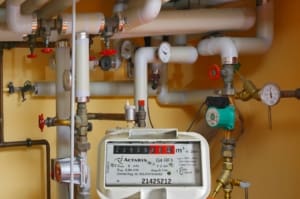
Heating
Decarbonising heat is one of the most significant and complex challenges for reaching net zero targets.
Heating of buildings accounts for around half of Scotland’s total energy consumption (SESH). For the public sector, natural gas dominates energy consumption in buildings and is the biggest source in terms of the total public sector footprint (Public Bodies Climate Change 2023/24 Analysis Report).
The Heat in Buildings Strategy sets out how the UK will decarbonise homes, and commercial, industrial and public sector buildings. By 2030, we must significantly reduce fossil fuel consumption —primarily natural gas—to meet emissions targets.
Approach to decarbonising Scotland’s buildings
A two-pronged approach is needed to decarbonise the heating of Scotland’s buildings:
- Improve the energy efficiency of building stock to reduce heat demand; and
- Accelerate the deployment of zero direct emissions heating systems (ZDETs) such as ground-source heat pumps or the combustion of sustainably sourced non-fossil fuels, to replace fossil fuel heating.
Properties should first be retrofitted to a sustainably energy efficient standard before installing ZDETs, to avoid unnecessary energy loss.
Electricity
Buildings also have significant emissions associated with their operational electricity use (e.g. for lighting and electronic appliances). In these cases, the resulting magnitude of GHG emissions is directly related to the carbon intensity of the electricity used (either from the national grid or from renewable microgeneration). Reducing electricity demand through behavioural change and the use of smart and energy-efficient technologies is extremely important.
Building Type and Energy Consumption
Non-domestic
Most publicly owned or controlled buildings are non-domestic. These vary greatly in size and energy consumption. The Heat in Building Strategy reports that 23,000 non-domestic buildings in Scotland are under public ownership, approximately 11% of the national total. Non-domestic buildings account for 12% of Scotland’s energy consumption and 7% of Scotland’s total greenhouse gas emissions.
Domestic
Around 12% of Scotland’s 2.5 million domestic homes are owned by local authorities to provide social housing. Domestic homes account for around 30% of Scotland’s total energy consumption (44 TWh) and approximately 80% of them use mains gas as their primary heating fuel.
A commonly used metric for building energy use is kWh/m2/yr – the energy use per square metre that is required by a building over a year. This includes regulated (i.e. hot water, space heating and cooling, lighting and ventilation) and unregulated loads (e.g. lifts, IT and appliances).
Scotland’s National Target Overview
Scotland has ambitious plans to reduce emissions in the building sector (domestic, public and commercial buildings) to reach zero emissions in 2045, as set out in the update to Scotland’s 2018 to 2032 Climate Change Plan. More specifically, the Scottish Government committed to developing phased decarbonisation targets from 2024 onwards, with all publicly owned non-domestic buildings expected to meet zero direct emission heating requirements by 2038.
Key Overarching Policies
- The updated Scottish Government Climate Change Plan (2025) sets policies out to 2040.
- The Energy Strategy and Just Transition Plan (draft, 2023) sets out a coherent whole-system vision for a just transformation of Scotland’s energy system to 2045 and a route map of ambitions and actions that will guide decision-making and policy support over the next decade. Chapter 4.1 discusses heat in buildings and the plan also discusses renewable heat generation and hydrogen.
- Heat in Buildings Strategy (Oct 2021) sets out a pathway to decarbonise Scotland’s building stock in line with our legislated climate change targets. It builds on the policies of the Climate Change Plan Update (2020), bringing together energy efficiency and heat decarbonisation ambitions into a single framework to provide an update to the Energy Efficient Scotland Route Map (2018) and the Heat Policy Statement (2015). It aligns with the Scottish Government and Scottish Green Party Shared Policy Programme (2021), the Housing to 2040 Strategy (Mar 2021) and the National Performance Framework. An update on progress against this strategy was published in 2022.
On the horizon… the Heat in Buildings Bill
- The Heat in Buildings Bill is a key piece of legislation currently in development, with the draft published in November 2025. It aims to turn the ambitions in the Heat in Buildings Strategy 2021 into developed long-term policy proposals, producing the promised regulatory framework for low-carbon heating and energy efficiency in existing buildings, and an overall framework for monitoring delivery. This will be crucial for the development of phased targets for all publicly owned buildings to meet zero-emission heating requirements. The bill is intended to be introduced once the Scottish Parliament returns after the Scottish Election in May 2026. In accordance with democratic processes, plans will need to take into account the outcome of the 2026 Scottish election.