Buildings: Embodied Emissions
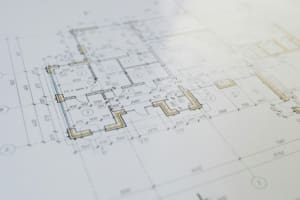
Embodied carbon is a critical issue in achieving net zero targets. It refers to the carbon emissions associated with the manufacture, construction, maintenance, refurbishment and demolition of a building.
Constructing new buildings can generate high levels of Greenhouse Gas (GHG) emissions due to the energy-intensive processes and significant material consumption. While building from scratch gives public bodies greater control over a building’s embodied carbon and an opportunity to embed excellent building energy efficiency, extending the lifetime of a building by renovation should always first be considered before replacement. Renovation is often a more efficient use of materials and energy. Where new construction is necessary, new buildings must be designed to achieve net-zero whole life-cycle carbon emissions.
A whole life cycle approach
A whole life cycle approach must be used to quantify the GHG emissions associated with buildings and infrastructure projects. An appropriate methodology should be applied from the earliest possible stage and be used to make visible the true costs of operational and embodied carbon to allow better-informed decision making about capital and operational expenditure.
A whole life carbon (WLC) assessment should:
- For building projects, follow the Royal Institution of Chartered Surveyors (RICS) Whole Life Carbon Assessment for the Built Environment guidance.It mandates a whole-life approach to reducing carbon emissions within the built environment and sets out specific mandatory principles and supporting guidance for the interpretation and implementation of EN 15978 methodology. This is compatible with the Scottish Government’s Net Zero Public Buildings Standard (see below).
- For infrastructure projects, follow PAS 2080: Carbon Management in Infrastructure.PAS 2080 is a globally applicable standard for managing carbon in building and infrastructure. It looks at the whole value chain and aims to reduce carbon and cost through intelligent design, construction, and use. It’s a key reference document in the UK government’s Construction Playbook that’s increasingly becoming the go-to specification for carbon management in the built environment.
Key guidance for public sector
- The Scottish City Region and Regional Growth Deals Carbon Management Guidance for Projects and Programmes (Sept 2021) developed by the Scottish Government for project owners on managing and minimising potential carbon emissions associated with growth deal projects.
This guidance uses PAS2080 as its framework and goes on to provide a streamlined system for assessing and prioritising action on carbon within growth deal projects. The guidance is also useful when considering carbon in infrastructure projects, buildings or as part of wider place-based climate plans. - SSN’s Climate Change Impact Assessment (CCIA) guidance for public bodies on developing their own CCIA framework to incorporate the carbon impact of buildings and infrastructure projects into their decision-making.
- The LETI Retrofit vs Rebuild offers guidance on how to compare whole life carbon for a retrofit versus its demolition and rebuild. The hierarchy for embodied carbon reduction emphasises building less over building clever. Extending the lifetime of a building by renovation should always first be considered before replacement, as this is often a more efficient use of materials and energy.
- Net Zero Public Sector Buildings Standard is a voluntary building standard which quantifies the energy performance of a building. Scottish public bodies should refer to this to ensure good practice for design and construction of new buildings and major refurbished infrastructure projects. The Standard
A main standard document sets out principles and approach and is accompanied by a suite of supporting documents (including Pathfinder case studies). Although currently aimed at new build and major refurbishments, this work is being extended to look at existing buildings.
More information about the Standard here:
-
- SSN 2022 Conference: Net Zero Public Sector Buildings & Reporting discusses the standard and helpful synergies between it and the PBCCDR
- SSN 2021 Conference: Mott MacDonald explaining the NZPBS.
Procurement
Public bodies should use their procurement power to support the decarbonisation of highly emitting steel and cement industries. The Climate Emergency Collaboration Challenge Project report discusses how the University of Edinburgh as a client can work more collaboratively with construction partners to deliver a zero-carbon built environment. It stresses that net zero priorities must be articulated from the outset and project governance must ensure these outcomes are maintained throughout delivery, early engagement and close collaboration with commercial partners is key. It provides further advice applicable to UK universities and public bodies.
Improved Building Design
The design of buildings is crucial to heat decarbonisation as this shapes a building’s energy consumption and subsequent emissions for decades. Apart from ensuring buildings have minimal embodied carbon, designs must ensure that new buildings are energy efficient and use decarbonised heating systems. Often, they also include integrating energy generation into buildings such as solar photovoltaics, solar thermal and passive heating via glazing. A building with net zero operational carbon does not burn fossil fuels and achieves a level of energy performance in-use in line with our national climate change targets. No carbon offsets can be used to achieve this balance.
Fabric first approach
A Fabric First Approach to construction considers the design and materials of a building’s envelope – frames, structure and insulation – in the initial design stages. It prioritises heat conservation rather than relying on decarbonised heat generation. Adopting this approach is critical to reducing energy demand and preparing buildings for zero-emission technologies. This is best achieved through:
- Maximising airtightness
- Increased levels of insulation
- Optimising solar gain through the provision of openings and shading
- Optimising natural ventilation
- Using the thermal mass of the building fabric
Passive house
Passive house (PassivHaus) is an international quality assured standard and methodology for achieving low energy building design based on the principle of reducing heating demand through a fabric first design. Buildings built to Passivhaus standards use up to 90% less energy for heating and cooling, and up to 70% less energy than conventional buildings. For technical specifications see here, this includes a space heating and cooling demand benchmark of 15kWh/m2/year, which far exceeds current building regulations. Passivhaus building characteristics and examples are shown here.
Material efficiency
Material efficiency improvements cover a broad suite of measures that lower energy needs through more efficient use and management of materials. Different material efficiency measures can be applied at the design, production, use and end-of-life stage of the supply chain for each type of good or service. Examples include measures to reduce material demand, use materials or production routes with lower lifecycle emissions and recycling materials at the end of product lifetimes.
Smart buildings
Digitalisation is an important enabler of energy efficiency and demand flexibility in buildings. These “smart” buildings benefit from advanced sensing and controls, systems integration, data analytics and energy optimization to actively reduce energy use and demand. The potential energy savings from smart buildings is significant. Basic automated building controls can save 10-15% of energy in commercial buildings. More advanced functionality, such as demand-controlled ventilation, can save an additional 5-10% in energy (World Economic Forum). In addition, grid-interactive Efficient Buildings (GEBs) can reduce energy costs through active demand management.